

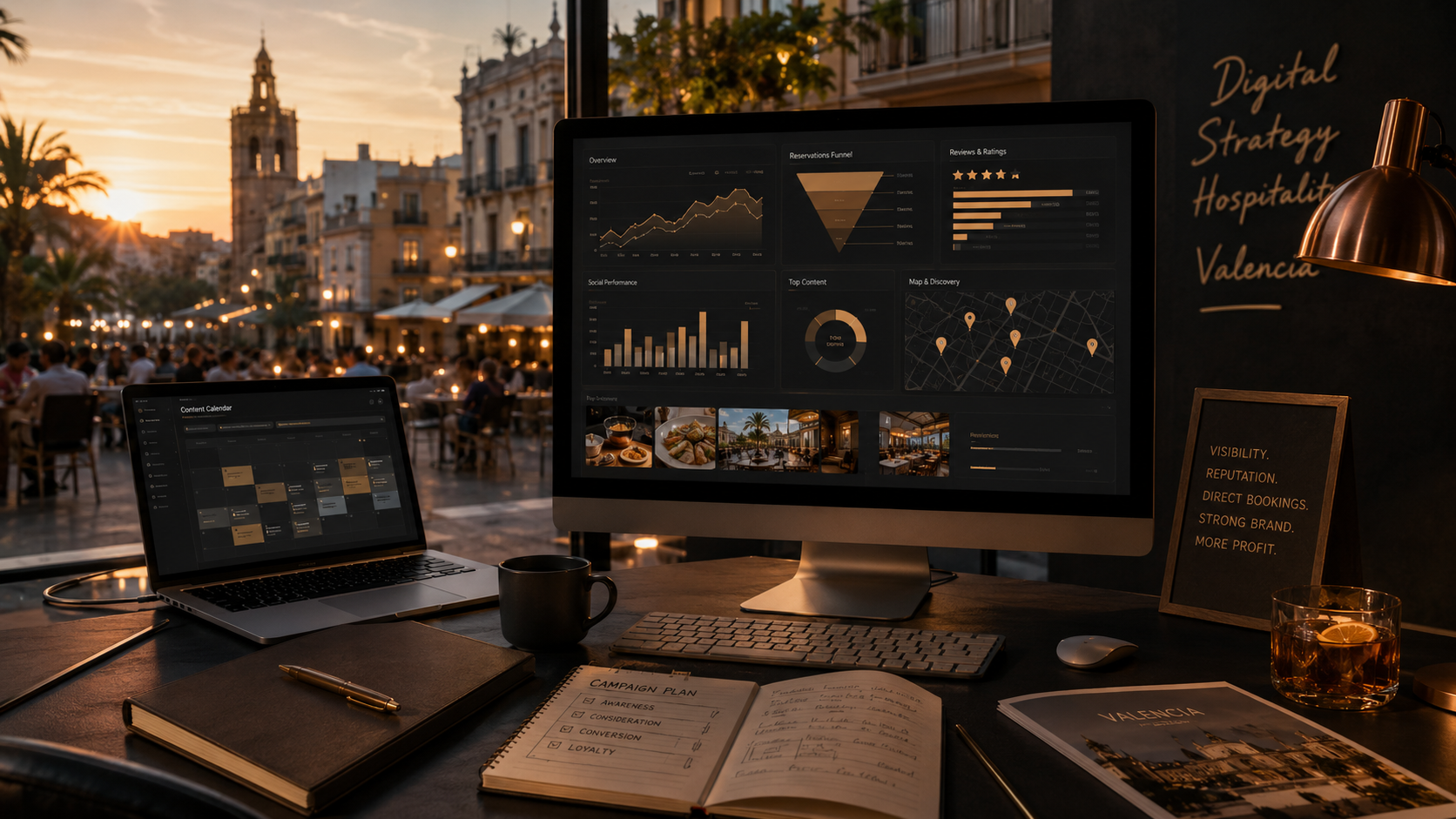
Valencia is going through a strong period as a tourist, gastronomic and cultural destination. There is movement, there is demand and more people are making decisions in the city. But that does not mean every business will benefit equally.
In hospitality, the business that wins is not automatically the one that is open. It is the one that appears first, communicates value more clearly and reduces customer doubt at the exact moment of decision.
According to Spain’s National Statistics Institute (INE), Spain received 10.26 million international tourists in May 2026, 9.5% more than in the same month the previous year. In the first five months of the year, the country accumulated 36.82 million international tourists, up 5.0%. Tourist spending also grew: in May it reached €13.553 billion, up 10.9%, and in the Comunitat Valenciana it reached €1.553 billion, with annual growth of 12.0%.
These figures show a clear opportunity. But they also show something else: when demand rises, competition does too.
More tourism does not mean more bookings for everyone
One of the most common mistakes in restaurants, hotels and lifestyle businesses is assuming that high season solves the commercial problem.
It does not.
Tourists, temporary residents and local customers compare before choosing. They search on Google Maps, look at photos, read reviews, check Instagram, observe the atmosphere, compare prices and often decide within minutes.
The question is not whether there are people in Valencia.
The question is: when that person decides where to have dinner, where to book, which hotel to choose or which experience to live, does your brand appear as a clear, trustworthy and desirable option?
The decision happens before contact
Before calling, booking or sending a message, the customer has already formed an impression.
That impression comes from small signals:
the quality of the photos,
the clarity of the profile,
visual consistency,
reviews,
ease of booking,
response on social media,
the type of content published,
the sense of real activity.
In today’s market, a brand can lose a booking without knowing it was being compared.
The customer simply chose another option that felt safer, more alive or more aligned with what they were looking for.
Valencia requires a more strategic digital presence
The Comunitat Valenciana continues to maintain strong tourism occupancy levels. For July 2026, average hotel occupancy forecasts for the region were above 83%, and the province of Valencia was forecast at 75.9%. In June, the city of Valencia reached hotel occupancy of 89.8%, according to data shared from Turisme Comunitat Valenciana.
This creates an important commercial window for restaurants, hotels, beach clubs, rooftops, premium experiences, tourism real estate and local brands.
But a commercial window is not used through random posts.
It is used through strategy.
Visibility has to become trust
Posting more does not always mean communicating better.
A brand can be active every day and still convey little value. It can have movement on social media but generate no desire. It can invest in ads but lose conversions because the profile does not inspire confidence.
Effective digital marketing does not start with making noise.
It starts with building a clear perception.
For a hospitality brand, that means showing:
real atmosphere,
well-presented product,
the team in action,
the full experience,
customers using the space,
service details,
social proof,
ease of booking.
When these elements appear consistently, the customer does not just see a post. They understand a proposition.
Visual content justifies value before the visit
In sectors such as restaurants, hotels and lifestyle, the customer buys an expectation before experiencing the service.
That is why visual production is so important.
A strong atmosphere video can make a table feel more desirable. Good product photography can elevate price perception. A real service sequence can convey care. An image of a full house can reduce perceived risk.
Content does not only show what exists.
It builds the sense that it is worth choosing.
Google, Instagram and reviews are decision points
For businesses in Valencia, Google and Instagram should not be treated as secondary shop windows.
They are decision points.
A customer searching for “restaurant near me”, “best dinner in Valencia”, “rooftop Valencia”, “paella experience”, “luxury hotel Valencia” or “fine dining Valencia” is much closer to deciding than someone who simply sees a post by chance.
If the brand does not appear well presented at those points, it hands the decision to the competition.
And if it does appear, but with weak photos, little information, neglected reviews or a poor visual experience, it also loses strength.
Social proof sells because it reduces risk
In hospitality, the customer wants signs of validation.
They want to know whether other people have been there, whether the atmosphere is real, whether the space is genuinely alive, whether the service looks considered and whether the experience matches the promise.
That is why social proof is one of the strongest assets in digital communication.
Real photos of activity, service videos, occupied tables, recent reviews and customer content help build trust.
The strategic document we used as a basis summarises this point clearly: the restaurant that communicates better appears first in the customer’s mind; the one that does not communicate hands the peak of demand to the competition.
High season should also prepare the next one
Marketing should not stop when the city is full.
The busiest months are also the best months to collect content, build remarketing audiences, encourage reviews and prepare the following months.
Every full table, every real service, every atmosphere video and every positive review can become an asset for future campaigns.
A smart brand does not use high season only to sell now.
It uses high season to build reputation.
Conclusion: being in Valencia is not enough
Valencia offers a strong opportunity for hospitality brands, restaurants, hotels and experience-led businesses.
But the opportunity does not automatically become a booking.
The brand needs to appear at the right moment, communicate value before contact, show a clear experience and make the customer’s decision easier.
In a city with high demand, a strong offer and growing competition, digital marketing stops being an extra.
It becomes part of commercial operations.
Because the customer may be nearby.
But the brand still has to be chosen.